
There's a creator somewhere right now writing an appeal to YouTube. Carefully worded. Respectful. Maybe even apologetic. Fourteen years of videos. 40,000+ subscribers. A disabled veteran who relied on that income for food and bills — terminated or demonetized by an algorithm in under 24 hours.
His appeal was rejected before a human could have reasonably watched even one of his videos.
He's not alone. In early 2026, YouTube's automated enforcement systems terminated or demonetized thousands of channels — many of them legitimate, human-made, years-in-the-making operations. The AI couldn't tell the difference between a spam farm and a guy filming food reviews in Sony Vegas with his own face and voice. It didn't care. Pattern matched. Terminated. Next!
And still, creators are writing appeals. Begging. Promising to be better. “He’s not always like this…” they say. But we all know that “he” - Youtube - will never change.
Let's talk about what's actually happening here.
You Are Not YouTube's Partner. You Never Were.
YouTube calls it the YouTube Partner Program. The name does a lot of work. Partner implies mutual investment, shared risk, good faith. It implies that when things go wrong, two parties sit down and figure it out together.
That is not what happens.
What happens is this:
- you spend years building an audience.
- You learn the algorithm.
- You produce consistently.
- You follow the rules — or at least the rules as they were explained to you, because they change without notice.
You build something real. And then one day, an automated system decides your content looks like something it doesn't like, and in the time it takes you to make a cup of coffee, your business is gone.
No call. No warning. No human on the other end (ironically).
The appeal form goes into the machine. The machine spits back a response. One creator documented their appeal being rejected in under five minutes — for original, handcrafted animation they'd spent years producing. Mathematically, no one watched those videos before issuing the denial.
This is not a partnership. In a partnership, you have standing. You have recourse. You have a seat at the table.
In this relationship, you have a content quota, a revenue split you didn't negotiate, and the right to appeal to the same machine that already decided against you.
The Economics of the Arrangement
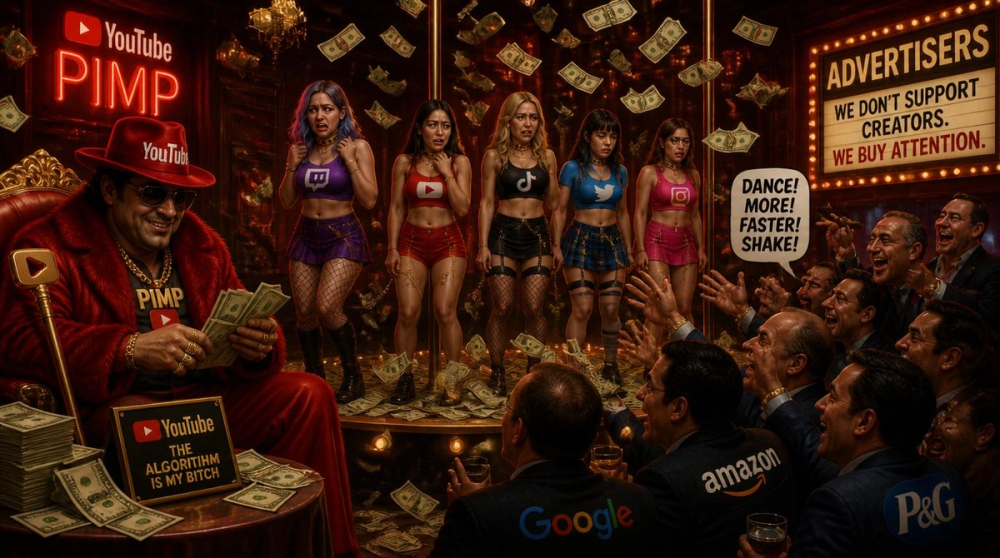
Let's look at the actual numbers, because this is where the pimp analogy stops being metaphor.
YouTube pays creators 55% of ad revenue on long-form content. They keep 45%. That sounds reasonable until you understand that you built the audience, produced the content, absorbed all the production costs, carried all the creative risk — and YouTube provided a server and an algorithm.
The platform generated over $60 billion in 2025 revenue across ads and subscriptions — more than Netflix, more than any entertainment company except Disney. They've distributed $100 billion to creators over the last four years combined. Those numbers sound impressive until you do the math: YouTube is keeping roughly the same amount they're paying out, while creators carry 100% of the production burden.
The advertisers are paying for access to your audience. YouTube just controls the door.
Your viewers think they're watching your channel. They're not. They're inventory. Ad impressions. CPM units. The advertiser buys access to the audience you spent years building, YouTube takes 45% of that transaction, and you get the rest — contingent on the algorithm having a good day.
And when the algorithm doesn't have a good day? A Kapwing study of 15,000 trending channels identified 278 high-traffic operations that had accumulated 63 billion views and an estimated $117 million in annual ad revenue. In January 2026, YouTube's enforcement wave hit. No severance. No transition period. Just terminated.
The specific cases that made it public: a Bible story channel with 588,000 subscribers lost $30,000 per month in ad revenue overnight. A real estate exam prep channel — content that genuinely helped people pass state licensing exams — lost $7,500 per month. Both were flagged for "inauthentic and mass-produced content." Neither fit any reasonable definition of a spam operation.
The Prostitution of AI
Here's the part that should make every creator furious.
In July 2025, YouTube renamed its "repetitious content" guideline to "inauthentic content" — broadening the policy scope from simple spam detection to anything that lacks what the platform considers genuine human creativity. Around the same time, YouTube's own leadership was publicly announcing new AI-powered creator tools, positioning Alphabet's products as synonymous with AI innovation.
Then it deployed AI moderation systems to terminate creators for using AI.
That's not a misunderstanding. That's the setup and the sting happening simultaneously. Use our tools. Accept our terms. Get flagged by our classifier. Appeal to our automated rejection system. Start over.
And the ToS? Legal analysts argue the updated terms require YouTube to "reasonably believe" a violation occurred before terminating a channel. When an algorithm flags a watermarked original video as stolen content, or classifies a consistent visual brand as a template spam operation, that's not a reasonable belief — that's a machine error. Whether a machine's pattern-matching failure satisfies the contractual standard of "reasonable belief" is the legal question now forming in courts. Some attorneys think it doesn't.
A class action case is plausible. The same legal infrastructure that took on OpenAI and Meta over training data is organized and looking for the next battleground. But even if a class action succeeds, it won't give you your channel back if it was terminated. It won't rebuild your audience. It won't return the years you spent building something on someone else's platform. For those who were demonetized, you lost expected revenue and the worst part of it is that Youtube will continue to monetize your “demonetized” videos. They say they won’t, but they do.
The Relationship You're Actually In
I want to say something that might be uncomfortable.
When a creator who's been demonetized writes a careful, apologetic appeal explaining that they'll change, that they didn't mean to violate anything, that they'll be more careful going forward — that is the language of someone in a hostile relationship who has been convinced the problem is them.
I should have been quieter. I should have changed. I must have done something wrong.
YouTube promoted AI tools and penalized you for using them. YouTube built a system where the algorithm can terminate your income before a human being is involved. YouTube's support replied to your appeal with a copy-pasted policy statement that didn't address your specific situation. YouTube's own creator awards were mailed to channels that were simultaneously being departnered by YouTube's own bots.
That's not a YOU problem.
The creator economy was built on a myth — that if you followed the rules, created good content, and grew an audience, the platform would honor that work. That myth died somewhere around 2025. In 2026, it's just a myth that a lot of people are still acting on.
YouTube in 2026: Still Necessary, No Longer Sufficient
Let's be precise about this. YouTube is not dead. It's the second-largest search engine on the planet. Two billion users. Algorithmic discovery that no other platform has replicated. The numbers are still real.
The Creator Business Model, though? That's what's dead.
Building a business on YouTube ad revenue in 2026 means building a business where the primary revenue source can be switched off by an automated system with no warning, no genuine human review, and no accountability to you as a business operator.
That's not a business. That's a job at a company that can fire you instantly and keep your severance and you get ZERO benefits. You’re basically a glorified intern working for tips.
So what does a real business look like?
The Math You Should Be Running Instead
You have 100,000 subscribers. Let's say YouTube demonetizes you tomorrow. What do you actually have?
You have 100,000 people who chose to spend time with you. Who found value in what you made. Who trust your taste or your expertise or your voice enough to come back.
If you convert 1% of that audience to a product or service priced at $100 — a course, a guide, a membership, a tool, a piece of software, a physical product they'd actually use — that's 1,000 sales. That's $100,000. Not contingent on the algorithm. Not contingent on YouTube's ad inventory. Yours.
Stretch that across a year with a $100 annual subscription model or segmented product deliverables, and you have a $100,000 recurring business that doesn't care whether YouTube had a good quarter.
The objection I hear is: but my content doesn't lend itself to a product. Maybe. But think harder. An entertainment channel built around a specific niche — cooking, fitness, finance, gaming, history — has a concentrated audience with a concentrated interest. That interest has an adjacent problem. That problem has a solution someone would pay for. You don't have to be obvious about it. You have to be strategic.
YouTube is a distribution channel. It's a good one. Use it. But the moment you treat distribution as the business, you've handed control of your business to someone else.
Stop Begging. Start Building.
If you've been demonetized, terminated, or shadowbanned — and you're spending your energy writing appeals and hoping YouTube reconsiders — I want to ask you a direct question:
What are you actually asking them to give back?
If the answer is "ad revenue," you're asking to be re-enrolled in a program that can terminate you again tomorrow with no notice and no recourse. You're asking for permission to be dependent again.
The better question is: what do I actually own?
Your content, if you backed it up. Your audience, if you have contact information or can rebuild it on a platform you control. Your expertise, which no algorithm can terminate. Your credibility, which compounds whether YouTube exists or not.
The creators who survive 2026 and build something durable won't be the ones who got their channels reinstated. They'll be the ones who looked at their audience — even a small one — and figured out how to serve that audience directly.
YouTube's not going anywhere. Neither are the terms that let them treat you this way.
The question is what you're going to build that doesn't depend on their permission.
If you're a creator trying to figure out what comes after the algorithm, book a strategy call and let's map out what you actually own.
Read the related case studies on what full-funnel digital infrastructure looks like when it's built for you, not for a platform: View Our Work
Sources
- Kapwing study — 278 AI slop channels, 63B views, $117M annual revenue estimate OutlierKit, citing Kapwing analysis of 15,000 trending channels (2026) https://outlierkit.com/resources/youtube-ai-slop-crackdown-2026/
- 16 channels terminated — 35M subscribers, 4.7B lifetime views, ~$9.8–10M annual revenue ScaleLab (April 2026) — https://scalelab.com/en/why-youtube-is-cracking-down-on-ai-generated-content-in-2026 Flocker (March 2026) — https://flocker.tv/posts/youtube-inauthentic-content-ai-enforcement/ OutlierKit (March 2026) — https://outlierkit.com/resources/youtube-ai-slop-crackdown-2026/
- Bible story channel ($30K/month) and real estate exam prep ($7,500/month) case studies Fliki, citing Sean Cannell / Think Media Podcast (March 2026) https://fliki.ai/blog/youtube-ai-demonetization
- YouTube "inauthentic content" policy rename — July 2025 Flocker — https://flocker.tv/posts/youtube-inauthentic-content-ai-enforcement/ OutlierKit — https://outlierkit.com/resources/youtube-ai-slop-crackdown-2026/
- YouTube 55/45 revenue split on long-form content YouTube official help documentation — https://support.google.com/youtube/answer/72902 YouTube Partner Program overview — https://blog.youtube/creator-and-artist-stories/youtube-partner-program-explained/
- YouTube $60B+ 2025 revenue; $100B paid to creators over four years Alphabet Q4 2025 earnings / SEC Form 8-K — https://www.sec.gov/Archives/edgar/data/0001652044/000165204426000012/googexhibit991q42025.htm Variety (February 2026) — https://variety.com/2026/digital/news/youtube-2025-total-revenue-ads-subscriptions-alphabet-earnings-1236652260/ Hollywood Reporter (February 2026) — https://www.hollywoodreporter.com/business/digital/youtube-made-more-than-60-billion-in-revenue-last-year-1236495310/
- YouTube revenue vs. Netflix ($45.18B in 2025) Media Play News (February 2026) — https://www.mediaplaynews.com/youtube-posted-record-60-billion-revenue-in-2025/
- YouTube as second-largest search engine Multiple sources including Bloggerspassion YouTube Statistics 2026 — https://bloggerspassion.com/youtube-statistics/